
The End Fed Half Wave antenna and why it's efficiency and core choice is so important
Updated: Feb 9
Before I move ahead with this blog post I want to just do a little background comment on why I have written it.
Over numerous years there have been lots of blogs, videos and commentary about how good or bad EFHW antennas are. Lots of advice, some good, some bad and some ugly, on how to set them up. Also, we see whole bunch of marketing nonsense related to power and no Tune no ATU stuff.
So, before I rabbit on, I just wanted to say at Radio-Stuff.com we do spend a lot of time testing our antennas and with over 800+ sold in the last three years we know a thing or two about how to build a good antenna. How to optimise them and the types of issues you may encounter when one is in use. Will cover the topics of power handling, efficiency and heat. If your interested in tuning antennas please look at our other blog for this.
So, let’s begin.
Power Handling
This subject is one of the most guessed at out of all the topics on the interweb. We see many quoted numbers, different terms like ICAS. Or 5kw SSB, or 1kw SSB with very little concern for the antenna design.
I would like to simplify things as much as possible here. We put our antennas pretty much into two categories Portable and QTH. We then state power handling capabilities based on testing.
When I see “Power 400w PEP, please note that the power ratings are ICAS 3 minutes RX/TX” and no description of the cores used in the transformer no efficiency numbers or the cycles of SSB, or Data you should expect.
We tend to view things a little differently based around what you are doing with the antenna.
Power rating for portable antennas.
When going portable (POTA/SOTA/BOTA) you will not be running 25w of FT8 into a portable antenna for 100% of the time over several hours. or a day. SSB QSO's tend to be quick and fast and not for more than an hour. Your activation is done and your on your way home. This is why it may seem a little odd our power ratings on Portable and QTH antennas are not always the same.
However, we do offer several Portable products which will handle QTH syle power. They just tent to be a little heavier.
QTH antennas.
For your QTH we are assuming you are either having a Ragchew, your on a Net or running something like FT8 or CW to get the DX station. With no real time limit to your operation and possibly more than 100w output.
Competition can add an additional level of stress onto your whole antenna system. You may will be running flat out from the start of a competition to the end. Possibly over 2 days. This can be hard on the transformer in the antenna. Also, in some instances high power is used and a tuner for WARC bands.
At Radio-Stuff.com our power ratings are based on where we think you are going to use the antenna for and where it is located.
See our antenna chart which will help you decide what antenna or kit to buy for which occation.
Efficiency
This one is super simple to explain and super complicated to get right on a multi band EFHW antenna.
We measure the efficient of the transformer as a percentage of the power put into the antennas transformer and what comes out in a value of loss (db). This gives us an indication of how much of the power you input into the antenna transformer makes it out to the antenna wire.
This is really simple to show in the graph below, (the number are nonsense, but it gets the point across. I probably could have done this better, but here we go.

If your transformer is 100% efficient then none of the power will stay in the core in the form of heat.
If your transformer if 0% efficient then 100% of the power will go into the core creating heat.
No antenna system I'm aware of is 100% efficient. Although there are quite a few amateurs who say there is, like a Dipole or Balanced antenna. The reality is there is loss all over the antenna systems of types. Loss in all parts of the system like your coax, antenna wire, connectors, ATU etc.
Anyway, lets get back on topic. When we measure the efficiency of a transformer and we quote an efficiency number we do for reasons. Firstly, to give an indication for how much power gets to the antenna wire and secondly to give us an idea how much power is tuned into heat.
The efficiency of any core is also not constant across all frequencies (bands). As an example here are efficiency measurements of a 2643251002 core in our 56:1 400w antenna and 3xFT240-43 in our 1KW model.


If we only focus on efficiency then surely the 2643251002 56:1 core is better than the 3xFT240-52 cores right, not quite and heres why.
The 2643251002 cores mass is 104g, whereas 3xFT240-52 (the proper name being 3x 2643251002) has a total mass of 390g. Also, the unit with the FT240-52 cores has a larger surface area which will cool quicker. More mass which means cores will head slower.
To give and example of why this is important lets look at FT8. When you transmit using FT8 the core will warm up a little every 15 seconds with a duty cycle of 50%. When you stop transmitting it cools a little, well it tries to cool down for 15 seconds. The cooling tends not to happen as quickly as it warms up, esspecially if the air around the core/s warms up as well. This is normally caused by putting the transformer into an exclusure.
The diagram below is not quite technically correct, but it gets the point accros. Over time the cores heat up.
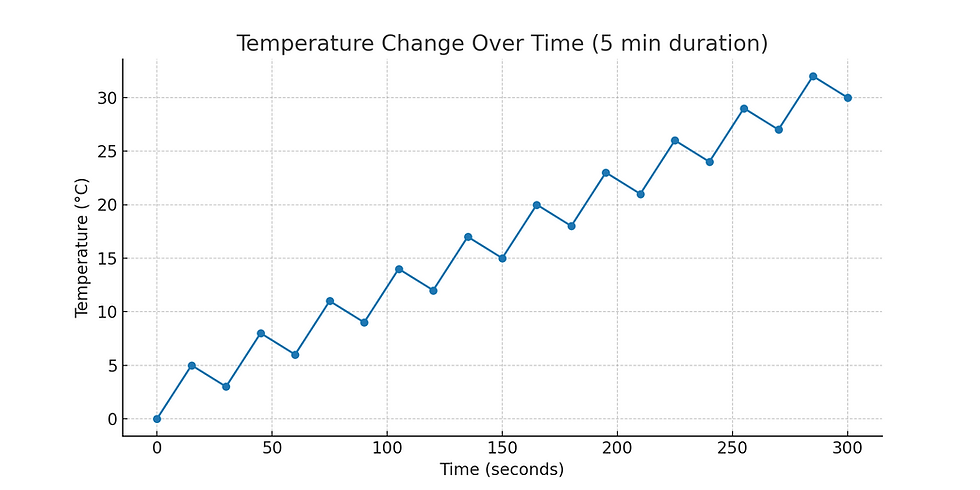
Core heating would not be a problem if heating did not cause two other possible problems.
Harmonics and the curie point of the core.
Again a simple graph based on a FT240-52 core, the timelines would be dependant on power.

On a lot of the forums and videos people focused on the curie point of the cores in an EFHW and not any harmonic issues heating can cause with an EFHW.
When a core gets too hot it can create harmonics whcih causes you to transmit not just on the intended band but also out of band. Meaning you could be transmitting on 80m and 40m at the same time, but at different powers. This is something to about about.
The curie temperature.
If you have used an EFHW and suddenly you see your SWR go high, very quickly. This is when you have hit the curie temprature of the core in the EFHW. This can destroy your finals in your transistor. To resolve this issue you will need to sop transmitting and wait until the core/s have cooled down and then its normally safe to transmit again. Unless you have caused serious damage to other components in the transformer or encluosure.
Different core/s mixes have different curie temprature so you will find some are more fogiving than others.
Tweaking efficiency of an EFHW.
You can tweak the efficiency of the transformer in an EFHW by using different windings. There are a couple of winding used in EFHW broadband transformers.
A more classic design which will have the widings evenly spaced around the core/s, normally with a cross over. Also you will see windings close together on say 1/3rd of a core (notmally called and Autotransformer). Some do a mix of both. We tend to keep out winding spread out around this core. This is done to ensure even heat distribution aroud the core/s and not focus too much heat on a single part of a core/s.
Some antenna designers belive that by using larger core like the FT 290-43 you can make a better transformer capable of handling more power.
The core type (Mix) and dimensions (Size) are critical to how an EFHW performs along with the amount of air in an enclosure and the winding size and style . We manufacture EFHW using FT290-43 core/s stacked. These cores can be very lossy at the higher bands and can translate 20%-60% of the input energy going into the core/s making it get warm quite quickly. Not good if you’re using FT8 on 15m with 250w. These cores are much better suited to low band EFHW antennas like 160m to 40m.
So efficiency and therefore heat is really important in this antenna design. At Radio-Stuff.com we base our designs on the intended use and also put the right core in the right antenna for its purpose.
A good example is any of our QTH antennas, they all come in oversized boxes which have enough air circulating in them, whilst keeping the elements out. Also, we mount all our QTH EFHW on our PCBs to help with efficiency and/or airflow over the cores. Also to ensure that if for any reason you push the transformer too hard the case does not melt.

I hope this has given a little insight as to why and how we rate the power of our products. I personally will never understand is why some customers buy antennas based on the numbers quoted by the retailer without even seeing what’s inside the box (usual do not open seal). Or where there is no efficiency statement or build quality view. This is super important if you’re going to be running power.
Last thought on efficiency. It goes both ways, if the antenna is inefficient on transmit it will be the same on receive.


Comments